Bypass Diodes in Solar Panels: Function, Failures, Symptoms and Troubleshooting Guide
Bypass diodes are a critical component inside solar PV modules that protect solar cells from overheating, reduce power loss during shading, and improve overall system reliability.
Although they are small electronic components, bypass diodes play a major role in preventing hot spots and potential module damage.
What Is a Bypass Diode?
A bypass diode is an electrical component installed inside a solar panel junction box.
Its main function is to allow current to “bypass” shaded or damaged sections of a solar module.
Most standard solar panels contain:
- 3 bypass diodes (one per substring of cells)
- Each diode protects a group of 18–24 cells
How Bypass Diodes Work
When a solar panel is operating normally, current flows through all cells.
However, when one section is shaded or damaged:
- That section produces less current
- It becomes a bottleneck in the series circuit
- Reverse voltage starts building up
- The bypass diode activates automatically
Normal operation:
Sunlight → All cell strings active → Full power outputShading condition:
Shaded cells → Reverse bias → Bypass diode activates → Current reroutesWhy Bypass Diodes Are Important
Bypass diodes help to:
✔ Prevent hot spots
✔ Reduce power loss during shading
✔ Protect solar cells from reverse current damage
✔ Improve system stability
Without bypass diodes, even small shading could cause severe overheating.
Common Bypass Diode Failures
1. Open Circuit Failure
The diode stops conducting completely.
Symptoms:
- Entire substring loses power
- Permanent power reduction
- No protection during shading
2. Short Circuit Failure
The diode becomes permanently conductive.
Symptoms:
- Constant bypass of cell string
- Significant power loss
- Reduced module efficiency
3. Thermal Degradation
Caused by long-term overheating.
Symptoms:
- Intermittent operation
- Unstable performance
- Increased resistance
4. Manufacturing Defects
Poor quality diodes may fail early.
Symptoms of a Faulty Bypass Diode
A failed bypass diode may cause:
- Sudden drop in power output
- One section of panel not producing power
- Hot spots near affected cells
- Thermal imbalance on IR camera
- Reduced performance during partial shading
- Inconsistent string voltage
How to Diagnose Bypass Diode Problems
1. Thermal Imaging
Faulty diodes often create:
- overheated cell strings
- uneven temperature distribution
2. IV Curve Testing
IV curve may show:
- step-like drops
- reduced fill factor
- abnormal knee shape
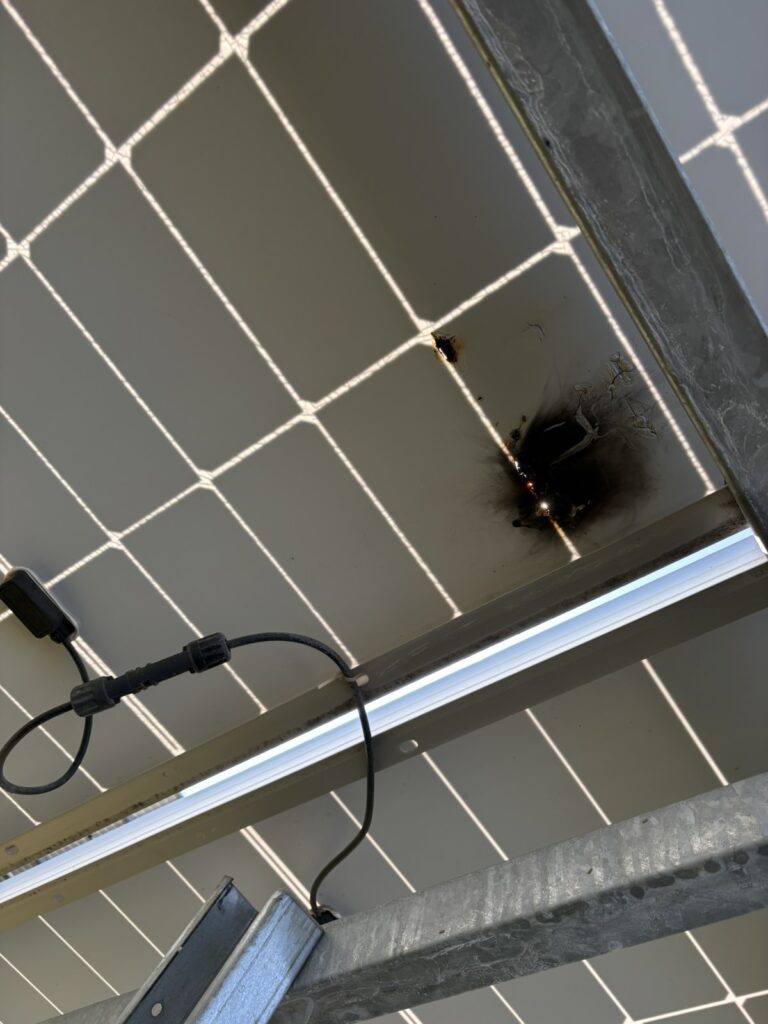
3. Visual Inspection
Look for:
- discoloration near junction box
- burn marks
- cracked encapsulation
4. String Voltage Testing
Compare string voltages:
| Condition | Voltage Behavior |
|---|---|
| Normal | Stable output |
| Faulty diode | Sudden voltage drop |
Bypass Diode vs Hot Spot
| Feature | Bypass Diode Failure | Hot Spot |
|---|---|---|
| Cause | Electrical component failure | Cell mismatch/shading |
| Location | Junction box | Cell area |
| Detection | Electrical tests | Thermal camera |
| Risk | Power loss | Overheating/fire risk |
Real-World Example
During a PV inspection, a solar string showed reduced output only during partial shading conditions.
Thermal imaging revealed one full substring of cells operating at abnormal temperature.
After inspection, a failed bypass diode in the junction box was identified as the root cause.
Replacing the module restored normal system performance.
Can a Faulty Bypass Diode Cause Fire?
Yes, in extreme cases.
If a diode fails and shading persists:
- heat buildup increases
- cell temperature rises
- insulation materials may degrade
- risk of hot spot formation increases
However, most failures result in performance loss rather than immediate fire risk.
Prevention Tips
To reduce bypass diode failures:
- Use high-quality PV modules
- Avoid long-term partial shading
- Perform thermal inspections
- Monitor string performance regularly
- Avoid overheating of junction boxes
Conclusion
Bypass diodes are small but essential components in solar panels. They protect modules from shading-related damage and significantly reduce the risk of hot spots.
A failure in a bypass diode can lead to power loss, thermal imbalance, and in some cases, increased risk of overheating.
Regular inspection and thermal imaging are the best ways to detect issues early and maintain PV system performance.
Solar Panel Hot Spots: Causes, Symptoms, Risks and Fire Prevention Guide